NEWS
The Urban Developer Exclusive: New Growth Engine: Lines Blur as Retail, Residential Mix Recalibrates
Click here to view the original article on The Urban Developer
Retail’s new frontier is mixed-use as developers invest more deeply in retail and shopping centre owners move into housing.
According to JLL, 46 per cent of US shopping mall redevelopments are now mixed-use, with almost 54 per cent of mixed-use redevelopments incorporating housing.
If Australia follows suit (with an estimated 8000-home pipeline planned on shopping centre sites already, according to CBRE) then the line between residential developer and retail developer will continue to blur.
Residential developers are increasingly seeing the value of retail, above and beyond a single convenience store on the ground floor; Melbourne developer Pellicano recognised the appeal at its five-tower South City Square in Brisbane, and Coronation Property has included 15,250sq m of retail and commercial space at its Inner West Precinct 75 development.
Coronation strategic adviser for retail and placemaking Joanna Russell says that retail in major precincts has become a must-have.
“Yes, that takes a bit more investment, and it takes a bit more strategic thinking and there’s a little bit more risk involved in it,” Russell says.
“You can hopefully command higher rents or sales because of it, but the benefits are not just short term, and so you certainly have to have a longer term view on creating an asset that will stabilise and have a greater level of occupancy.”
The rise of mixed-use retail
Woodbridge Capital co-founder and managing director Andrew Torrington says that mixed-use retail is not a passing trend.
“We’re seeing strong national momentum toward repositioning retail into mixed-use because it’s a better outcome for everyone: residents get amenity, retail gets daily frequency, and precincts get resilience,” Torrington says.
“The winners are the projects built around strategic location, real community demand, and multiple exit pathways not ‘retail for retail’s sake’.”
The residential-retail blur is a rational response to the pressures of housing supply and the need to keep retail offerings relevant across more hours of the day, Investorkit partner for commercial investments Chris Huxter says.
“CBRE explicitly links mixed‑use momentum to retailers wanting more trade after 5pm, with centres trialling gyms and evening dining to capture that spend,” Huxter says.
“In precinct terms, that means your food and beverage mix, lighting, safety and seating design are not cosmetic. They are performance drivers.”
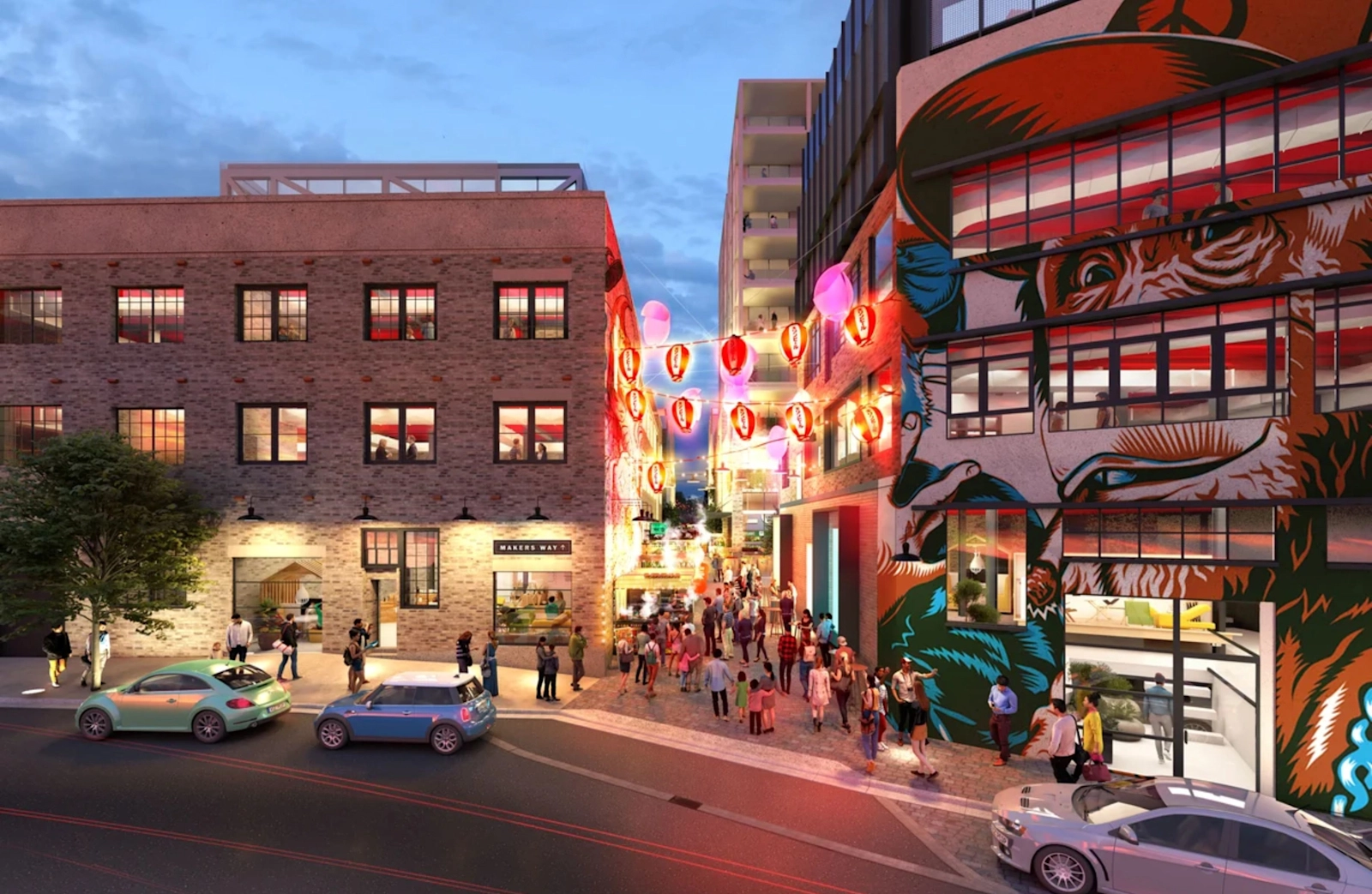
Precinct 75 is heavily indexed towards food and beverage, Russell says, with offerings surrounding a central lawn area.
It is currently on the hunt for a convenience operator, which is no mean feat given the proclivities of major supermarket retailers towards larger footprints.
Coronation is also exploring creative uses for the site, drawing on its history as a Brooklyn-style hub for artists and creatives—and the birthplace of Taubmans Paint—to provide a point of difference.
Return on retail investment
Russell acknowledges that returns can be a little intangible, particularly with build-to-rent.
“Retail can drive vibrancy, and foot traffic from outside of the catchment and that’s incredibly important,” she says.
“But does it improve the ability to easily lease? Do you have reduced vacancy because of the amenity, and do you have a greater number of leasing renewals because of the amenity you provide? That’s harder to define.”
Even so, developers are increasingly confident in retail’s value, Russell says.
“We’re doing our own analysis on what is the correct amount of retail that goes into a development, and there’s always guidance from the planning legislation around the split of GFA between residential and retail,” Russell says.
“So there needs to be a very relevant conversation about what’s the right amount of retail to put in.
“And in certain locations, we’ve pushed for what we think is the right amount.”
Huxter says that the challenge for retail in mixed-use is planning, zoning and built-form rules.
“Even when a council likes the idea of mixed‑use, details like active frontages, loading, waste rooms, acoustic separation, signage, and trading hour controls can reshape feasibility fast.”
So the considered approach to mixed-use retail is always the best.
“It’s a sensible evolution, as long as the retail component is treated as a real business, not a ground‑floor ‘nice to have’,” he says.
“Retail’s job is not “max rent per square metre”. Retail’s job is to make the precinct work every day, then make the numbers work.”
Giving buyers what they want
Torrington says successful retail increasingly reflects buyer behaviour.
“Convenience wins, every time,” Torrington says.
“People want fast, frictionless retail—parking that works, easy access and a reason to be there beyond “buy a thing”.
“Tenants are chasing certainty and flexibility: centres that drive consistent foot traffic, support omni-channel, like click-and-collect and returns, and offer right-sized spaces with leases that reflect reality, not like it’s 2019.
“The strongest retail is becoming service-led and experience-led—health, wellness, dining, community uses—because that’s what keeps people coming back.”
Property Council of Australia executive director for its Retail Property Australia division William Power says convenience and experience are central to all retail offerings.
“We’re seeing demand for experiential retail that you can’t replicate online. Things like food and beverage, health and wellness, entertainment,” Power says.
“These consumer preferences are driving the design and placement of tenancies and the role they play in a wider precinct experience.”
Russell says wellness uses are increasingly supplementing an expected convenience retail offering.
“Recovery-type offerings like bathhouses and infrared clinics are very popular, and that’s a real growth area to meet the health and wellness expectations of residents and the wider catchment,” Russell says.
But versatility is key to a good retail offering, she says.
“You have to be a little bit flexible, because the market changes. New offers come to market, particularly the growth of Instagram and other social media, and you respond to what you see really resonates with a particular market.”
Existing assets and future fundamentals
In the pure retail sector, Torrington says growth is centred on intensification and repositioning rather than new supply, and it’s something Woodbridge would consider if it stacks up.
“The big theme is intensification and repositioning: upgrading what already exists and embedding retail into broader precincts where it’s supported by rooftops and infrastructure,” Torrington says.
But there’s a lot developers can learn from the pure retail side, says Huxter.
“In mixed‑use, the strongest baseline is daily‑needs retail, because it drives repeat visits,” Huxter says.
“CBRE notes that 94 per cent of shopping centres have at least two daily‑needs supermarkets, and those supermarkets form a meaningful part of GLA. That tells you where demand sits in the real economy.”
Creating communities
Power says that retail property remains one of the most community-connected asset classes.
“People still need places to shop, eat, and gather and retail precincts are social infrastructure that reflect consumer demand and confidence in real time,” Power says.
While the sector underpins vibrant communities and is an economic pacesetter, there are challenges that can constrain its positive impact, he says.
“High operating costs are made worse by ill-designed levies and charges across states, while regulatory complexity makes development and investment more challenging and planning delays impact project viability.
“Investors, owners and developers are responding by focusing on projects with strong fundamentals, pursuing mixed-use formats that hedge risk, investing in technology and sustainability, and working closely with the government on practical reform where it is needed.”
Huxter notes occupancy rates reached 98 per cent in 2025.
“Then add population growth of 400,000 people a year who are going to need more shopping centres, but we can’t build them.”
Mixed-use precincts, alongside neighbourhood centres, will increasingly be required to meet that demand.